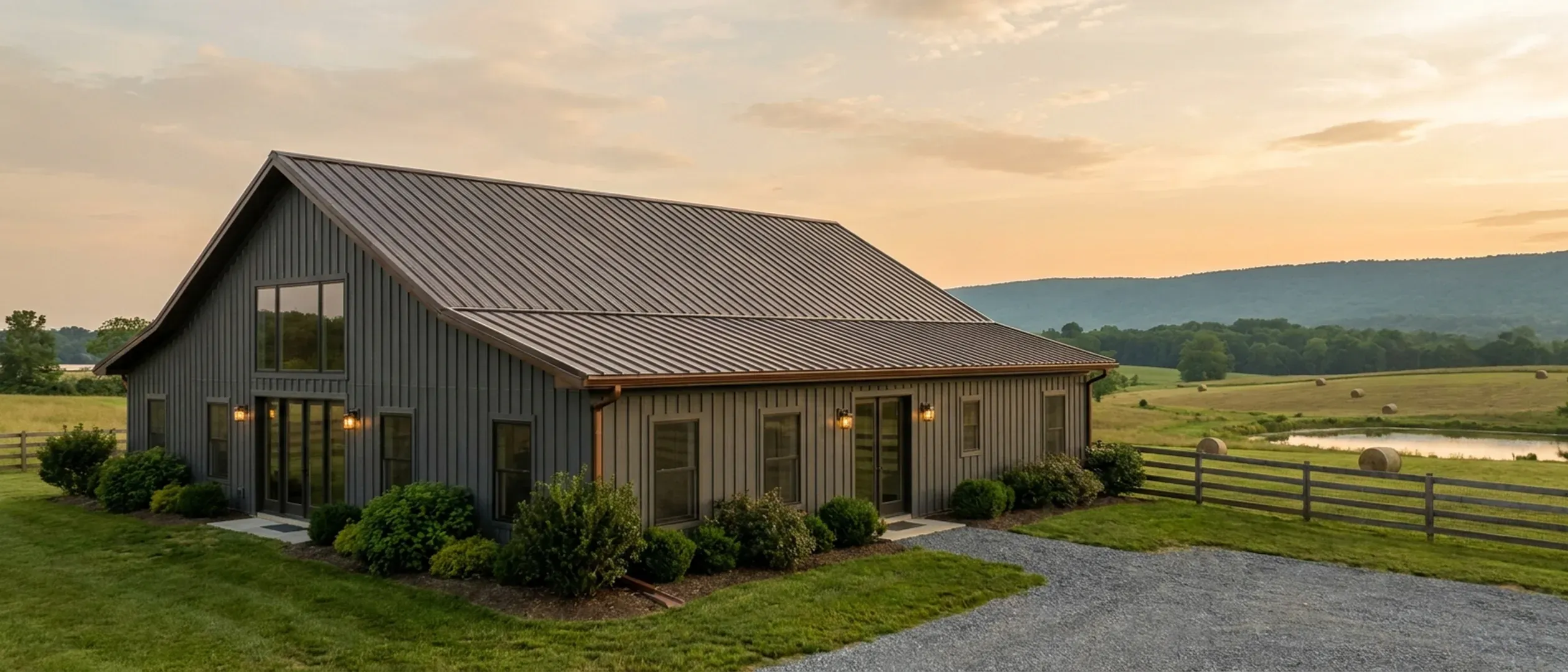
How Long Does It Take to Build a Barndominium in Maryland?
How long a barndominium takes in Maryland depends less on the building than on what happens before the first column goes up: the land, the septic approval on a lot without sewer, the design, and the county's permit review. Once those are done, a kit shell goes up quickly and the rest is the same trade sequence as any house. Maryland has one delay that catches many rural buyers: on clayey or wet soils, the county health department can only perc test in the wet season it sets each year, which in Carroll and Anne Arundel counties opens in February, so missing the window can cost a year. For a benchmark, the Census Bureau's Survey of Construction reports that single-family houses started in its South region in 2025 took an average of 9.0 months from start to completion when built by a contractor on the owner's land, and 10.8 months when the owner acted as the builder. Those are conventional houses, not barndominiums, and the months before the start are extra.
Figures on this page are cited third-party or government data, not a quote from Maryland Barndominium Builders.
Bottom Line Up Front
- Most of the calendar is spent before construction starts: land checks, the septic approval from the county health department, the design, and the county's permit review. Starting those early is the biggest single saving.
- On some rural lots the perc test can only be done in the wet season. Carroll County's health department generally tests those soils from February 1 to April 15, and Caroline County's says applications should be in before December 1, so a lot bought in summer may not be tested until the next spring.
- As a benchmark, the Census Bureau reports 9.0 months from start to completion for contractor-built single-family houses started in its South region in 2025, and 10.8 months for owner-built ones, after an average of about a month and a half from permit to start.
The stages, and what each one waits on
Some of these overlap, and the order of the first few can change. The later stages cannot be rushed past their inspections or the weather.
1. Land due diligence
Before buying or committing to a site: the zoning, any covenants, whether the lot is in the Chesapeake Bay Critical Area or a flood hazard area, whether it has passed a perc test or when it can be tested, and access. The legal guide covers each check.
2. Perc test and septic approval
On land without public sewer, the county health department tests the soils and approves the septic area before a septic permit can be issued. On wet-season soils this is tied to the late winter and spring window, and the application has to be in well before it.
3. Survey, site plan and well
A boundary survey and site plan fix where the house, septic area, well and driveway go. A Maryland-licensed well driller gets the well permit from the county's approving authority, and both the septic and well permits have to be issued before the county can issue the building permit.
4. Plans and frame engineering
Floor plan, kit or frame selection, and the manufacturer's engineering for the frame, designed for the snow, wind and frost figures the building official sets for the site.
5. County approvals and the building permit
Zoning, health department, and any stormwater, grading, Critical Area or forest conservation review that applies, then the building permit itself. The county sets the review time, and each round of corrections adds to it.
6. Utility locate, then site work
Clearing, grading, the driveway and the building pad after the Miss Utility notice has run. A wet spring can hold this stage up.
7. Foundation
Footings and a slab, or piers or posts, designed for the soil and the frost depth the building official sets for the county.
8. Shell and dry-in
Frame erection, then roof and wall panels, doors and windows. A kit arrives as a package, so this stage is often faster than framing a conventional house.
9. Rough-ins, insulation and drywall
Licensed trade contractors handle plumbing, electrical and HVAC rough-ins, each inspected before it is covered. Then insulation, air sealing and vapour control, which in a humid Maryland summer matter more in a metal building than in most houses.
10. Septic and well installation
The septic system is installed to the approved design and inspected, and the well is drilled and tested, on the health department's schedule.
11. Final inspections and occupancy
Final inspections, then the county's use and occupancy certificate. You can move in once it is issued.
What makes a Maryland schedule longer
Most delays are predictable, which means most can be planned around.
Missing the perc window
A lot on wet-season soils that is bought in late spring or summer usually cannot be tested until the next wet season. A dry winter can shorten or cancel the season, as Carroll County's health department warns.
Approvals outside the permit office
Critical Area review near tidal water, a forest conservation plan where one is required, stormwater and grading approvals, and agency reviews such as Montgomery County's WSSC and M-NCPPC sign-offs each run on their own clock.
Incomplete applications and revised plans
The published review times are for complete applications. Each correction round adds review time, plus the time to revise.
Land that was not checked
Discovering a failed perc test, a flood hazard area, the Critical Area buffer or a covenant problem after the land is bought can add months or end the project on that lot.
What makes it shorter
The time savings in a barndominium are real, but they are concentrated in a few stages.
Buy land that has already passed
A lot with a current perc approval, or a property status report from the health department, removes the biggest seasonal risk. Caroline County's health department notes that even a previously perced lot is not guaranteed a permit if conditions or rules have changed, so ask.
A kit arrives as a package
Pre-engineered frame, panels and trim delivered together shorten the shell stage compared with framing a house on site.
Front-end work in parallel
The survey, perc test, design and frame engineering can run at the same time, so the permit application goes in complete.
Decisions made before the start
Changes after the shell is up cost the most time. Fixing the plan and the finishes before the permit application avoids re-review.
Reading this because you are weighing a build? The next step is a plan drawn for your program.
What's different about Maryland
A national survey gives the benchmark
The Census Bureau's Survey of Construction reports that single-family houses started in its South region in 2025 averaged 9.0 months from start to completion when contractor-built on the owner's land, and 10.8 months when owner-built. The average from permit authorization to the start of construction was 1.5 months for contractor-built houses and 1.6 months for owner-built ones. These are conventional houses. A barndominium's shell can go up faster, but the finishing trades and inspections take as long as in any house.
Wet-season perc testing
Maryland's septic rules require percolation tests to be done when the water table is expected to be highest at the disposal area, as the Carroll County Health Department explains. Where water tables are deep and the soils are not very clayey, tests can run year round; other sites are restricted to the wet weather season, generally February 1 to April 15 in Carroll County, with the dates adjusted each year and the season shortened or cancelled in a dry year. Anne Arundel County's health department puts its wet season typically between February 1 and April 30.
Apply early for the testing window
Caroline County's health department says perc test applications take up to 30 days to process, not counting the testing window, strongly encourages applying before December 1, and says final determinations of site suitability take a minimum of three months. Carroll County's requires the surveyor's plan by February 28 for testing that season. Missing those dates can move the test, and everything after it, to the following year.
County permit review
Review times are set by each county, not by the state. Montgomery County's Department of Permitting Services says it is committed to completing code review of a new home within 4 weeks, with WSSC and M-NCPPC reviews also needed before the permit issues. Carroll County says permits can normally be issued within 10 to 15 business days for a complete, code-compliant application. Frederick County's plan review gives initial comments on a new dwelling in two weeks. Each correction round adds time.
Weather
NOAA's State Climate Summary for Maryland puts the annual number of nights below freezing at more than 100 in the northwest and fewer than 20 in the southeast, and lists nor'easters, blizzards and tropical storms among the weather the state is exposed to. Winter site work and foundations are harder to schedule in Western Maryland than on the Lower Eastern Shore, and an open shell near the coast is exposed until it is dried in.
Three full business days before any digging
Miss Utility says that in Maryland you must contact it at least 3 full business days, and no more than 12 business days, before you begin excavation. On the Eastern Shore the one-call centre is Delmarva 811. Build the notice into the schedule before site work starts.
Pros and cons, honestly
Pros
- A kit shell goes up faster than a framed house of the same size.
- Front-end steps can run in parallel.
- Several counties publish their permit review times.
- A lot with a current perc approval removes the biggest seasonal risk.
Cons
- Wet-season perc testing can push a rural lot's schedule back a year.
- Critical Area, forest conservation and stormwater reviews add their own time where they apply.
- Each round of permit corrections adds review time.
- Winter in Western Maryland and coastal storms near the water slow site work.
How long does it take to build a barndominium in Maryland?
When can a perc test be done in Maryland?
How long does a building permit take in Maryland?
How long does septic approval take?
Can I build a barndominium through a Maryland winter?
Do I need to call before digging on my land?
When can I move in?
Is a kit barndominium faster than a stick-built house?
Questions answered? Tell us what you want to build and we will put real numbers against it.
Sources
- U.S. Census Bureau, Survey of Construction: average length of time from start to completion (by region and purpose) — South region, 2025: contractor built 9.0 months, owner built 10.8; read 27 Sep 2026.
- U.S. Census Bureau, Survey of Construction: average length of time from authorization to start — South region, 2025: contractor built 1.5 months, owner built 1.6; read 27 Sep 2026.
- Carroll County Health Department, Percolation Tests/Wet Weather Testing — Wet weather testing season, plan deadline and why; read 27 Sep 2026.
- Anne Arundel County Department of Health, Perc Testing — Wet season testing typically February 1 to April 30; read 27 Sep 2026.
- Caroline County Health Department, Septic Systems and Sewage — Testing window, December 1 application advice, processing and determination times; read 27 Sep 2026.
- Montgomery County Department of Permitting Services, Residential New Homes, Single Family and Townhouses Permit Process — Code review within 4 weeks; WSSC and M-NCPPC reviews; read 27 Sep 2026.
- Carroll County Government, Building a New Home or Addition — Permits normally issued within 10 to 15 business days for complete applications; read 27 Sep 2026.
- Frederick County, Building Permit Information Checklist for Single Family Dwelling (Detached) — Plan review initial comments in two weeks for new dwellings; packet dated July 2026; read 27 Sep 2026.
- NOAA NESDIS, Maryland and the District of Columbia State Climate Summary 2022 — Nights below freezing by region; nor'easters and tropical storms; read 27 Sep 2026.
- Miss Utility, home page — Maryland notice at least 3 full business days before excavation; read 27 Sep 2026.
Keep reading
The pages that answer the next question this one raises.
Can you build a barndominium in Maryland?
Permits, zoning, the Critical Area, septic and wells.
Read itPermitting
How the permit application and approvals come together.
Read itSite preparation
Clearing, grading and the building pad once approvals are in place.
Read itBarndominium kits
What arrives in a kit and how fast the shell goes up.
Read itBarndominium pros and cons in Maryland
Condensation, storms, covenants, septic and appraisal.
Read itStart the survey
Tell us where your land is and what you want to build.
Read itWant a real number instead of a range?
Start the survey and tell us about your land and what you want to build. Include the county and the tax map and parcel number if you have them, because in Maryland the county, the land-use rules that cover the parcel and the perc, septic and well answers change the budget more than the building does. The survey costs nothing.