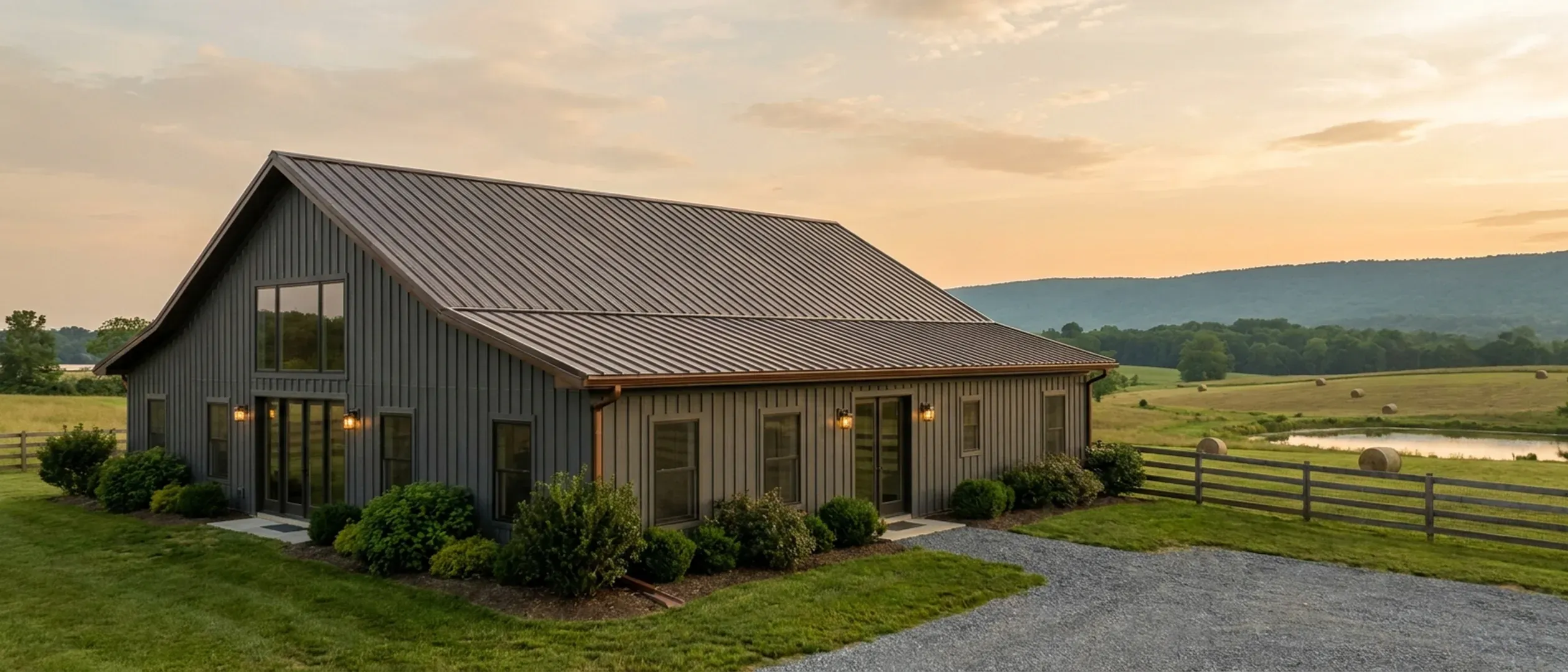
Can You Build a Barndominium in Maryland?
Yes. Maryland has no rule against barndominiums. A barndominium is a house with a steel or pole barn frame, and Maryland treats it like any other house. The Maryland Building Performance Standards apply to it: that is the statewide code the Maryland Department of Labor adopts and your county enforces. It has to be allowed by the local zoning; and on a lot with a well and septic system, the county health department has to issue both permits before the building permit can be issued. What decides whether you can build one on a particular lot is the land: the zoning, whether the soils pass a perc test, and whether the lot is in the Chesapeake Bay Critical Area, under an agricultural preservation easement, or covered by forest that the Forest Conservation Act protects. This page sets out who approves what, as of September 2026, and what to check before you buy land or apply. It describes the rules; it is not legal advice, and the county and the agencies named here have the final word on any lot.
Figures on this page are cited third-party or government data, not a quote from Maryland Barndominium Builders.
Bottom Line Up Front
- Barndominiums are allowed in Maryland as houses. The Maryland Building Performance Standards, currently based on the 2021 International Residential Code, apply to them statewide, and new one- and two-family homes need an automatic fire sprinkler system.
- Your county, or the town where a town runs its own building department, issues the building permit, inspects the work and issues the occupancy certificate. Local zoning decides whether a house and shop are allowed on the lot, and on land with a well and septic system the health department's permits come first.
- On many rural lots the harder questions are about the land: wet-season perc testing, the Chesapeake Bay Critical Area near tidal water, agricultural preservation easements, forest conservation and stormwater on a large footprint.
Are barndominiums allowed in Maryland?
Yes, as long as the building is designed, approved and built as a house on land where a house is allowed.
A barndominium is a house
There is no separate category for barndominiums in the Maryland Building Performance Standards. A steel or pole barn frame with a home inside is a one- or two-family dwelling, permitted and inspected like any other, with the same sprinkler and energy requirements.
The lot decides
Whether you can build one on a particular lot depends on the local zoning and on the land rules that apply there: septic, the Critical Area, forest conservation and stormwater. Those are the questions to answer before buying land.
What the rules do not allow
Building without a permit, living in a building that was permitted as a barn or shop, or starting on land with a well and septic system before the health department has issued both permits. Maryland's septic rules, COMAR 26.04.02.03, bar the county from issuing the building permit until it has.
Who approves what
Several offices may be involved. Which ones depends on where the land is.
The county building department
Reviews the plans, issues the building permit, inspects the work and issues the use and occupancy certificate, under the Maryland Building Performance Standards. Inside some incorporated towns, the town does this instead. In unincorporated places such as Columbia, Waldorf or Germantown, it is the county.
The county or town zoning office
Confirms the house and any shop are allowed on the lot and meet setbacks and height limits, or hears a request for a variance if they do not.
The county health department
Runs the perc test and issues the septic permit, under rules set by the Maryland Department of the Environment, which delegates that authority to local health departments. Your well is drilled by a Maryland-licensed well driller, who gets the well permit from the same county approving authority, and the water must pass lab tests before the well is used for drinking water.
The county's Critical Area and forest reviews
Where the lot is in the Chesapeake Bay Critical Area, or clearing or subdivision brings in the Forest Conservation Act, the county applies those rules alongside zoning. Check the county's Critical Area map before you buy.
The county's stormwater review
If building the home disturbs more than 5,000 square feet of ground, the county must approve a stormwater plan, using small-scale environmental site design, before it issues the permit.
Land rules that may apply to your lot
None of these bans a barndominium. Each can decide whether a particular lot works.
Perc tests and septic
Where the water table rises seasonally, the health department runs the perc test in the wet season, when the water table is highest, and each county sets its own testing season, so ask yours when it opens. Carroll County's health department, for example, generally tests those soils from February 1 to April 15. New homes in the Chesapeake Bay or Atlantic Coastal Bays Critical Area need a nitrogen-removing Best Available Technology (BAT) septic system, serviced every year; outside the Critical Area a conventional system is allowed unless the county requires BAT.
The septic tiers
Maryland's septic tier maps limit how rural land can be divided: under Environment Article §9-206, only a small, minor subdivision on septic is allowed in a Tier IV area. The tiers govern splitting land, not building one house on an existing lot that can pass a perc test. Ask the county planning office which tier a parcel is in.
The Chesapeake Bay Critical Area
Land within 1,000 feet of tidal water or tidal wetlands is usually in the Critical Area. There you face a buffer of at least 100 feet from the water, lot-coverage limits (commonly 15 percent) and, in resource conservation areas, one home per 20 acres. A large barndominium with a long driveway can reach the coverage limit on a small waterfront lot. Check the county's Critical Area map before you buy.
Agricultural preservation easements
Farmland under a state agricultural preservation (MALPF) easement generally cannot take a new house; the limited lot rights belong to the landowner who sold the easement. In Montgomery County's Agricultural Reserve, according to the county's Office of Agriculture, zoning allows one house per 25 acres.
The Forest Conservation Act
Clearing forest for your own home is exempt from the Act if you clear no more than 20,000 square feet of forest. Larger clearing, or subdividing or grading 40,000 square feet or more, brings in a forest conservation plan.
Stormwater
A development that disturbs 5,000 square feet or less is exempt from the state stormwater rules. Above that, the county approves a stormwater plan before the permit. A big shop, house, septic area and driveway can pass 5,000 square feet quickly.
Kit, modular or manufactured
The three are approved in different ways in Maryland.
A barndominium kit
Maryland's industrialized building law, Public Safety Article §12-301, excludes open frame construction that can be completely inspected on site. A steel or pole barn kit is erected on your land and permitted and inspected by your county like any site-built home. See barndominium kits.
A modular home
Built in a factory, certified by the Maryland Department of Labor and marked with a green state label. Even for a modular home, zoning, setbacks and site work stay with your county.
A manufactured home
Built to the federal HUD code on a permanent chassis, and carries a red HUD label. Before buying any prefab product, ask which of the three it is.
What to check before you buy land or apply
Each of these can be answered before you commit to a lot or a design.
Zoning for the actual lot
Ask the county, or the town if the lot is inside an incorporated town, whether a house and the shop you want are permitted, and what setbacks and height limits apply. Read any recorded covenants too.
The septic and well answer
Whether the lot has a current perc approval, or when the county health department can test it. On wet-season soils, apply well before the season opens.
The Critical Area map
Whether any part of the lot is in the Critical Area on the county's map, not just how far it is from the water.
Easements and tiers
Whether the land is under an agricultural preservation easement, and which septic tier it is in if you plan to divide it.
Forest and clearing
How much forest the house, shop, septic area and driveway would clear, against the 20,000 square foot exemption.
The design figures
The snow load, wind speed and frost depth the county building official uses for the site, before a kit is ordered.
Reading this because you are weighing a build? The next step is a plan drawn for your program.
What's different about Maryland
One state building code, enforced locally
Maryland homes are built to the Maryland Building Performance Standards, which adopt the International Residential Code. The edition in force is the 2021 code, adopted in COMAR 09.12.51 and effective since May 29, 2023, according to the Maryland Department of Labor, which adopts the standards. Labor published proposed changes to move to the 2024 editions in the Maryland Register on June 26, 2026; they had not been adopted as of September 2026. Each county adopts a new state edition on its own timetable, within 12 months of the state, so ask the county which edition applies to your permit.
Local amendments, with limits
Under Public Safety Article §12-504, counties can amend the state code for local conditions, but they cannot weaken its energy-efficiency, wind-design or home-sprinkler requirements. Your county's code may differ in detail from the model code, but never on those three.
Sprinklers in every new house
Section R313.2 of the 2021 International Residential Code, which Maryland adopts, says an automatic sprinkler system shall be installed in one- and two-family dwellings. A county can relax this only for a home that is not connected to the electric utility. A barndominium someone lives in is a dwelling, so budget a line for the sprinkler system from the start.
A home is never a farm building
Maryland's building code law says an agricultural building does not include a place of human residence, in Public Safety Article §12-508. However the building looks, and whether or not it stands on a farm, a barndominium someone lives in is permitted and inspected as a house.
Design figures are set for the site
Maryland does not set one snow load, frost depth or wind speed for the whole state. Under section R301.2 of the 2021 International Residential Code, the local jurisdiction sets those figures, so the county building official gives you the numbers for your site and the frame is designed to them. Garrett County in the mountains and Worcester County on the coast face very different snow and wind.
Who draws the plans
Maryland's architecture law, Business Occupations and Professions Article §3-103, lets a builder draw the plans for a single-family home it is building, and lets you draw plans for your own home, without an architect's seal. Steel-frame and pole barn homes usually fall outside the code's standard framing tables, so under section R301.1.3 of the 2021 International Residential Code the structure is designed by a licensed professional engineer. The county decides what sealed drawings it needs.
Pros and cons, honestly
Pros
- One state building code applies everywhere, so a barndominium is reviewed like any house.
- No special category or ban applies to barndominiums.
- A kit erected on site is permitted and inspected like any site-built home.
- You can pull the permit yourself as an owner-builder on your own land.
Cons
- Every new house needs an automatic fire sprinkler system.
- Some soils can only be perc tested in the county's wet season.
- The Critical Area limits lot coverage and building near tidal water.
- Preservation easements generally rule out a new house on eased farmland.
- Large footprints can trigger stormwater and forest conservation review.
Are barndominiums legal in Maryland?
Do I need a building permit for a barndominium in Maryland?
Does a barndominium in Maryland need fire sprinklers?
Can I build a barndominium on agricultural land in Maryland?
Can I build a barndominium near the water in Maryland?
Is a barndominium kit a modular home in Maryland?
Do I need an architect for a barndominium in Maryland?
Can I build my own barndominium in Maryland?
Questions answered? Tell us what you want to build and we will put real numbers against it.
Sources
- Maryland Department of Labor, Building Codes Administration: Frequently Asked Questions — 2021 codes effective May 29, 2023; read 27 Sep 2026.
- Maryland Department of Labor, Building Codes Administration: What's New — Proposed move to the 2024 codes, published June 26, 2026; read 27 Sep 2026.
- COMAR 09.12.51.04, Maryland Building Performance Standards: incorporation by reference — 2021 IBC, IRC and IECC; read 27 Sep 2026.
- Annotated Code of Maryland, Public Safety Article §12-504 (local amendments) — Energy, sprinkler and wind provisions may not be weakened; off-grid exception; read 27 Sep 2026.
- Annotated Code of Maryland, Public Safety Article §12-505 (local enforcement) — Counties and some towns issue permits, inspect and issue occupancy certificates; read 27 Sep 2026.
- Annotated Code of Maryland, Public Safety Article §12-508 (agricultural buildings) — A place of human residence is not an agricultural building; read 27 Sep 2026.
- International Code Council, 2021 International Residential Code, Chapter 3 (R301.1.3, R301.2, R313.2) — Engineered design, locally set design criteria, sprinklers; read 27 Sep 2026.
- Annotated Code of Maryland, Public Safety Article §12-301 (industrialized buildings: definitions) — Open frame construction inspected on site excluded; manufactured homes on a permanent chassis; read 27 Sep 2026.
- Maryland Department of Labor, modular and manufactured home definitions — Green state label for modular, red HUD label for manufactured; read 27 Sep 2026.
- COMAR 26.04.02.03, septic and well permits before the building permit — read 27 Sep 2026.
- COMAR 26.04.02.04, percolation testing when the water table is highest — read 27 Sep 2026.
- COMAR 26.04.02.07, Best Available Technology for nitrogen removal — Critical Area new construction; county option elsewhere; yearly service; read 27 Sep 2026.
- Maryland Department of the Environment, Well Construction — Licensed well driller applies to the county approving authority; read 27 Sep 2026.
- Carroll County Health Department, Percolation Tests/Wet Weather Testing — Wet weather testing generally February 1 to April 15 in Carroll County; read 27 Sep 2026.
- Annotated Code of Maryland, Environment Article §9-206 (septic tiers) — Minor subdivisions on septic in Tier III and Tier IV areas; read 27 Sep 2026.
- Annotated Code of Maryland, Natural Resources Article §8-1807 (Critical Area) — 1,000 feet beyond tidal wetlands and the heads of tides; read 27 Sep 2026.
- Annotated Code of Maryland, Natural Resources Article §8-1808.3 (lot coverage) — Lot coverage limited to 15 percent; read 27 Sep 2026.
- COMAR 27.01.09.01, Critical Area buffer — Buffer of at least 100 feet; read 27 Sep 2026.
- COMAR 27.01.02.05, Resource Conservation Areas — One dwelling unit per 20 acres; read 27 Sep 2026.
- Annotated Code of Maryland, Agriculture Article §2-513 (MALPF easements) — No residential use of eased land except limited releases; read 27 Sep 2026.
- Montgomery County Office of Agriculture, Agricultural Reserve — One house per 25 acres in the AR zone; read 27 Sep 2026.
- Annotated Code of Maryland, Natural Resources Article §5-1602 (Forest Conservation Act applicability) — 40,000 square feet; owner's home exemption up to 20,000 square feet of forest; read 27 Sep 2026.
- COMAR 26.17.02.05, Stormwater Management: applicability — Developments disturbing 5,000 square feet or less exempt; read 27 Sep 2026.
- Annotated Code of Maryland, Business Regulation Article §4.5-601 (building permits; owner-builders) — read 27 Sep 2026.
- Annotated Code of Maryland, Business Occupations and Professions Article §3-103 (architecture exceptions) — Builders' own single-family construction; owners' own homes; read 27 Sep 2026.
Keep reading
The pages that answer the next question this one raises.
Permitting
How the permit application and approvals come together.
Read itHow long a barndominium build takes
Wet-season perc testing, county review times and the stages in order.
Read itBarndominium pros and cons in Maryland
Condensation, storms, covenants, septic and appraisal.
Read itBarndominium kits
Kits, modular and manufactured, and how each is approved.
Read itSite preparation
Clearing, grading and the building pad once approvals are in place.
Read itStart the survey
Tell us where your land is and what you want to build.
Read itWant a real number instead of a range?
Start the survey and tell us about your land and what you want to build. Include the county and the tax map and parcel number if you have them, because in Maryland the county, the land-use rules that cover the parcel and the perc, septic and well answers change the budget more than the building does. The survey costs nothing.