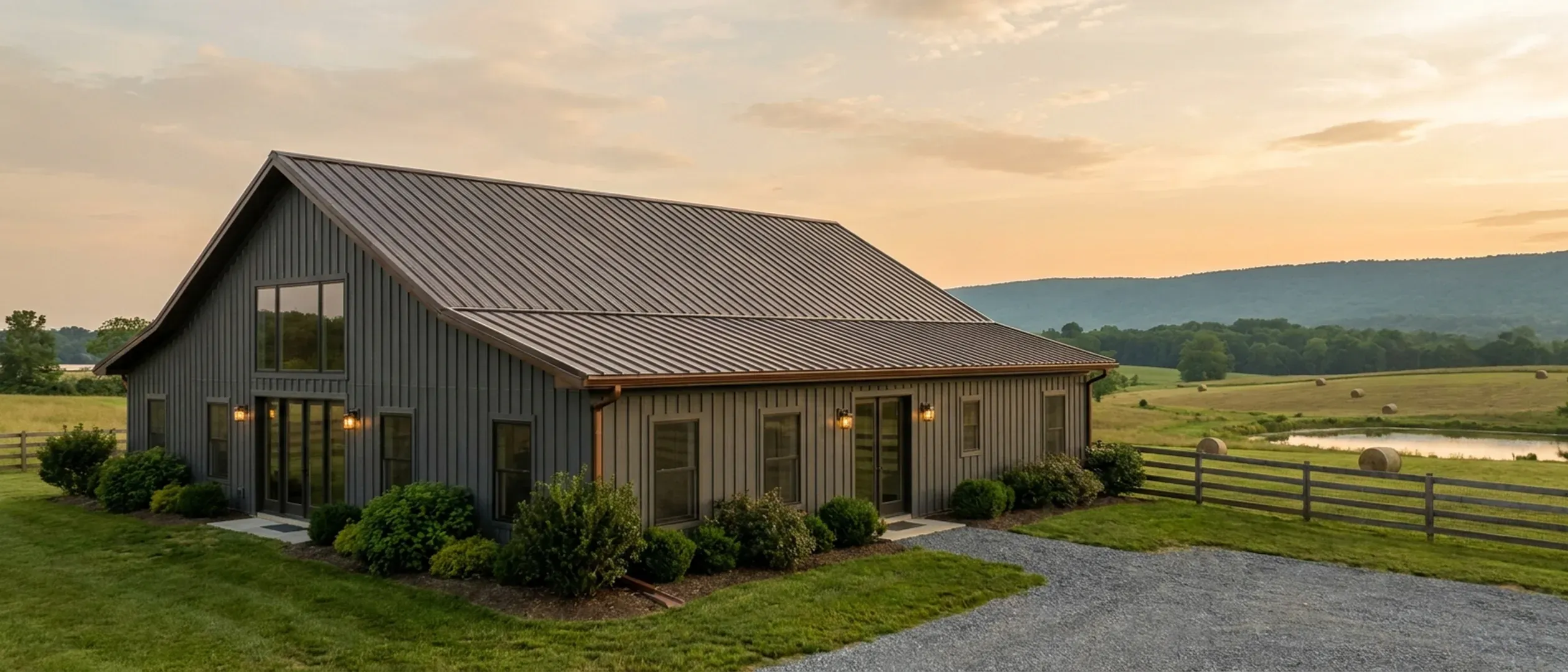
Barndominium Pros and Cons in Maryland
Most pros-and-cons lists for barndominiums are written for everywhere at once, which makes them true nowhere in particular. This one is written for Maryland. Some of the advantages are structural and hold anywhere: a clear-span shell, and a shop and a house under one roof. Several of the drawbacks are Maryland-shaped: warm, humid summers that punish a badly detailed metal building with condensation; nor'easters and tropical storms on the Bay and the Atlantic coast; flood that a standard homeowners policy does not cover; covenants in the suburbs that may not allow a metal-sided house; soils that can only be perc tested in the wet season; and appraisal where comparable sales are thin. Every claim below names its source. Where the honest answer is that it depends, the page says what it depends on.
Figures on this page are cited third-party or government data, not a quote from Maryland Barndominium Builders.
Bottom Line Up Front
- The genuine advantages are a clear-span shell with no interior bearing walls, a shop or equipment bay under the same roof as the house, and a kit shell that can go up faster than a framed house of the same size.
- The Maryland-specific drawbacks are mostly about the site and the climate: humid summers that make condensation control essential in a steel building, wind and flood exposure near the Bay and the coast, covenants in suburban subdivisions, septic soils, and appraisal with few comparable sales.
- None of these is a reason not to build one. Each is a reason to check the land, the covenants, the insurance and the appraisal before you commit, and to design the building envelope properly.
Three different buildings, one word
"Barndominium" covers several ways of building. The pros and cons are not the same for each.
Pole barn construction
Wood posts or columns carry the roof, usually with metal roof and wall panels. It is widely built across rural Maryland and the Eastern Shore, and it is often the most economical barn-style frame. See pole barn homes.
Steel frame
A pre-engineered steel frame with metal panels, often bought as a kit. It gives the widest clear spans. It also conducts heat and cools quickly, which is why condensation control matters most here. See steel construction.
Conventional framing with metal cladding
A wood-framed house with the barn look: metal roof, board-and-batten or metal siding, a gable profile. It appraises and insures most like any other house, but it gives up the clear span.
Where a barndominium genuinely wins
These advantages hold anywhere in Maryland, and they are the reasons most people choose one.
Clear span and a floor plan you can change
With no interior bearing walls, the inside can be laid out freely and rearranged later. Moving a wall is a finish job, not a structural one.
Shop and house under one roof
A workshop, equipment bay, boat or RV garage under the same roof and on the same foundation as the house. For someone who would build both anyway, this is the whole case. See shouses.
Tall walls and big doors
Tall sidewalls and wide overhead doors are routine in a barn frame, where in a conventional house they take special engineering.
A faster shell
A kit arrives as a package: frame, panels and trim. Erecting it is usually quicker than framing a house of the same size on site, though the rest of the build follows the same trades and inspections. The build timeline guide sets out where the time really goes.
A metal roof
Metal roof panels shed rain and snow well and suit the long, simple roof lines of a barn form.
Where it is weaker, and what to do about it
Each of these can be managed. None of them can be ignored.
Condensation in a humid climate
Maryland's humid summers and cold winter nights both drive moisture toward cold metal. The answer is a continuous air barrier, insulation that keeps the inside face of the panels above the dew point, a vapour retarder placed for the climate, and mechanical ventilation and dehumidification sized for the house. The Building America Solution Center's advice is to keep moist outside air out through sealing, tight ductwork and a pressure-balanced HVAC system. Licensed trade contractors design and install the HVAC.
Appraisal and comparable sales
Fewer barndominiums have sold, so an appraiser may lean on older or more distant sales, and a large shop may be valued at less than it cost. Talk to a lender that has financed one before you finalise the design. See barndominium financing.
Covenants in the suburbs
Many subdivisions in the D.C. and Baltimore suburbs have a homeowners association or recorded covenants that control exterior materials, building size and outbuildings. A metal-sided house or a large shop may simply not be allowed, whatever the county zoning says. Read the recorded covenants and the association's rules before you buy the lot.
A big shop is not always big value
A shop costs real money and adds value only if the next buyer wants one too. Size it for how you will use it, not for what the frame can span.
Heat on a metal skin
A dark metal roof absorbs a lot of summer sun. A light-coloured or reflective roof, a well-insulated roof assembly and shaded glazing on the west side all reduce the cooling load in a Maryland July.
Maryland conditions to plan for
These are about the land and the location more than the building. Check each one for the actual lot.
Septic soils and the wet season
On land without public sewer, the county health department has to approve the soils before a septic permit can be issued. Where the soils are clayey or the water table is shallow, Carroll County's health department explains, testing is restricted to the wet season, generally February 1 to April 15 there, and a lot that passes in summer can fail in March. Plan the purchase around that window.
Wind and flood near the water
On the Eastern Shore, in Southern Maryland and along the Bay's tidal rivers, get a flood zone determination and an insurance quote on the actual design before buying. The frame and its anchorage are engineered for the wind speed the building official sets for the site.
Very large footprints
A large shop and house can push a lot past stormwater, forest or lot-coverage thresholds that a smaller house would stay under. The legal guide sets out which approvals apply where.
Storm timing
An open shell is exposed until it is dried in. Scheduling frame erection outside the peak of the tropical season, where that is possible near the coast, and having the roof on quickly reduce the risk.
Reading this because you are weighing a build? The next step is a plan drawn for your program.
What's different about Maryland
Humid summers, and condensation behind the metal
NOAA's State Climate Summary for Maryland describes "moderately cold and occasionally snowy winters and warm, humid summers." That combination is exactly what a metal building has to be detailed for. The Building America Solution Center, run for the U.S. Department of Energy, puts the mechanism plainly: humid air moving through a building will "condense on any surface whose temperature is below the dew point." Steel panels and girts change temperature quickly, so in a barndominium the insulation, air sealing and vapour control have to be designed as one system rather than added at the end.
Nor'easters and tropical storms near the water
NOAA lists tropical storms and hurricanes, nor'easters, severe thunderstorms, tornadoes, blizzards and ice storms among the extreme weather Maryland is exposed to. It records that Hurricane Irene in 2011 "caused considerable wind damage along the coast," and that Sandy in 2012 brought a storm surge of 4 to 5 feet that flooded Crisfield and other low-lying parts of the Lower Eastern Shore. The design wind speed for a building is set for its site by the building official, not by a single statewide figure, so ask what applies to your lot before you order a kit.
A wide range of winters
The same NOAA summary puts the annual number of nights below freezing at more than 100 in the northwest of the state and fewer than 20 in the southeast. Garrett County and Worcester County are not designed for the same way. Snow load, frost depth and wind speed for your building come from the building official for your county, and a frame engineered for one end of Maryland may not suit the other.
Flood is a separate policy
The Maryland Insurance Administration's consumer guide to homeowners insurance says most standard homeowners policies "do NOT cover damage caused by rising waters," and that flood insurance is a separate coverage, much of it written through the National Flood Insurance Program. On low land near the Bay or its tidal rivers, price flood insurance on the actual lot before you buy it.
Wind deductibles
The same guide explains that some Maryland homeowners policies carry a separate deductible for wind, hurricanes or other storms, sometimes written as a percentage of the dwelling coverage rather than a flat amount. Ask each insurer how its wind deductible works on a steel or pole barn house before you choose a design, and ask about the discount the guide says insurers must offer for qualifying storm-mitigation improvements.
Appraisal where comparable sales are few
Fannie Mae's Selling Guide treats unique or nontraditional houses as eligible for its loans when the appraiser has enough information to reach a reliable value, and notes that rural areas with little sales activity may not have three truly comparable recent sales. It also says large barns and similar outbuildings can suggest a property is agricultural rather than residential, which the lender then has to resolve. A barndominium with a large shop on acreage can run into both.
Pros and cons, honestly
Pros
- A clear-span shell with no interior bearing walls, so the floor plan can change later.
- A shop, equipment bay or oversized garage under the same roof as the house.
- Tall walls and wide doors are routine rather than expensive.
- A kit shell can go up faster than a framed house of the same size.
- A metal roof suits the long, simple barn roof line.
Cons
- Humid summers make condensation control essential in a steel building.
- Wind and flood exposure near the Bay and the coast must be designed and insured for.
- Suburban covenants may not allow a metal-sided house or a large shop.
- Clayey or wet soils can restrict septic testing to the wet season.
- Fewer comparable sales can make appraisal harder.
- A large shop may not add value in proportion to what it cost.
Are barndominiums a good idea in Maryland?
Do metal barndominiums have condensation problems in Maryland?
Can a barndominium handle a hurricane or a nor'easter?
Does homeowners insurance cover flood damage to a barndominium?
Can my HOA stop me building a barndominium?
Are barndominiums hard to appraise?
Are barndominiums hot in a Maryland summer?
Is a pole barn home or a steel barndominium better in Maryland?
Questions answered? Tell us what you want to build and we will put real numbers against it.
Sources
- NOAA NESDIS, Maryland and the District of Columbia State Climate Summary 2022 (Technical Report NESDIS 150-MD) — Humid summers, nor'easters, Irene and Sandy, nights below freezing; read 27 Sep 2026.
- Building America Solution Center (PNNL for the U.S. Department of Energy), Building Science Introduction: Moisture Flow — Condensation below the dew point, air sealing, vapor retarders; read 27 Sep 2026.
- Maryland Insurance Administration, A Consumer Guide to Homeowners Insurance — Wind and hurricane deductibles, flood exclusion, mitigation discounts; read 27 Sep 2026.
- Fannie Mae Selling Guide B4-1.3-05, Improvements Section of the Appraisal Report — Unique or nontraditional housing; properties with outbuildings; read 27 Sep 2026.
- Fannie Mae Selling Guide B4-1.3-08, Comparable Sales — Rural properties and scarce comparable sales; read 27 Sep 2026.
- Carroll County Health Department, Percolation Tests/Wet Weather Testing — Wet weather testing season and why clayey soils are tested in it; read 27 Sep 2026.
Keep reading
The pages that answer the next question this one raises.
Can you build a barndominium in Maryland?
Permits, zoning, the Critical Area, septic and wells.
Read itAre barndominiums worth it in Maryland?
When one makes sense, and what to check first.
Read itHow long a barndominium build takes
The stages in order, and the Maryland delays to plan for.
Read itPole barn homes
Post and beam barn framing for a home and shop.
Read itSteel construction
Pre-engineered steel frames and wide clear spans.
Read itStart the survey
Tell us where your land is and what you want to build.
Read itWant a real number instead of a range?
Start the survey and tell us about your land and what you want to build. Include the county and the tax map and parcel number if you have them, because in Maryland the county, the land-use rules that cover the parcel and the perc, septic and well answers change the budget more than the building does. The survey costs nothing.